After a run of 2026 oral SERD approvals, Erica L. Mayer, MD, MPH, discusses ESR1 testing and a possible adjuvant role for giredestrant.
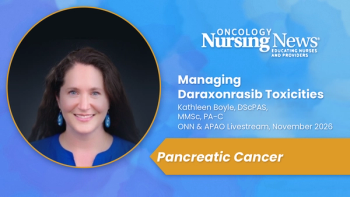
A Dana-Farber PA recalls the ASCO plenary where daraxonrasib nearly doubled pancreatic cancer survival and what the oral drug means for care teams.
When the phase 3 RASolute 302 results were presented at the 2026 ASCO Annual Meeting plenary session, Kathleen Boyle, DScPAS, MMSc, PA-C, was in the audience. The trial showed that daraxonrasib (Rasonque) nearly doubled median overall survival vs chemotherapy in previously treated metastatic pancreatic cancer, bringing care teams a new oral therapy with new management demands.1
Boyle, a physician associate in the Gastrointestinal Cancer Center at Dana-Farber Cancer Institute and president-elect of the Association of PAs in Oncology (APAO), spoke with Oncology Nursing News in a livestream on the Instagram channels of Oncology Nursing News and APAO for Pancreatic Cancer Awareness Month.
The meeting was Boyle's first ASCO, and the presenter was her Dana-Farber colleague Brian M. Wolpin, MD, MPH. As Wolpin began announcing the overall survival result, "he couldn't finish because a room of 10,000 people kind of came to their feet in spontaneous applause," she said.
"I will acknowledge it was pretty electric," Boyle said. "I think all of us felt some relief in having an option for folks with pancreas cancer when previously it had felt a bit like our hands were tied."
In the open-label trial, 500 patients with metastatic pancreatic ductal adenocarcinoma who had received 1 prior line of therapy were randomly assigned 1:1 at 59 sites in 6 countries to daraxonrasib 300 mg orally once daily or investigator's choice of chemotherapy.1 In the overall population, median overall survival was 13.2 months with daraxonrasib vs 6.7 months with chemotherapy (hazard ratio for death, 0.40), and median progression-free survival was 7.2 vs 3.6 months. Treatment-related adverse events led to discontinuation in 1.2% of patients receiving daraxonrasib vs 11.2% receiving chemotherapy.1 The results were presented at the plenary and published simultaneously in the New England Journal of Medicine on May 31, 2026.
"I mean, the numbers speak for themselves," Boyle said. "An increase from 6.7 to 13.2 months for a whole cohort of folks who average survival with metastatic disease is approximately 12 months. So this is dramatic."
Benefit extended beyond patients with RAS G12 mutations to the overall population. "This drug benefits patients with or without this targeted KRAS mutation," Boyle said.
The FDA approved daraxonrasib on August 26, 2026, for adults with metastatic pancreatic adenocarcinoma who have received at least 1 prior systemic therapy or who are not candidates for multiagent systemic therapy, as
Moving from infusion to a daily pill shifts where the work happens. “[Daraxonrasib], being an oral medication, takes a lot of the collaborative efforts between the advanced practice providers, the physicians, the program nurses, and the infusion nurses," Boyle said. "And it really takes the infusion quite out of that picture because they're not going for their 3- to 4-hour infusions every other week."
That shift places adherence monitoring, symptom triage, and education with the clinic team, a theme nurses also raised in
1. O'Reilly EM, Wainberg ZA, Hendifar AE, et al. Daraxonrasib or chemotherapy in previously treated metastatic pancreatic cancer. N Engl J Med. Published online May 31, 2026. doi:10.1056/NEJMoa2605555
2. FDA approves daraxonrasib for metastatic pancreatic adenocarcinoma. Oncology Nursing News. August 26, 2026. Accessed November 24, 2026.
3. Daraxonrasib in pancreatic cancer: what oncology nurses need to know. Oncology Nursing News. June 18, 2026. Accessed November 24, 2026.